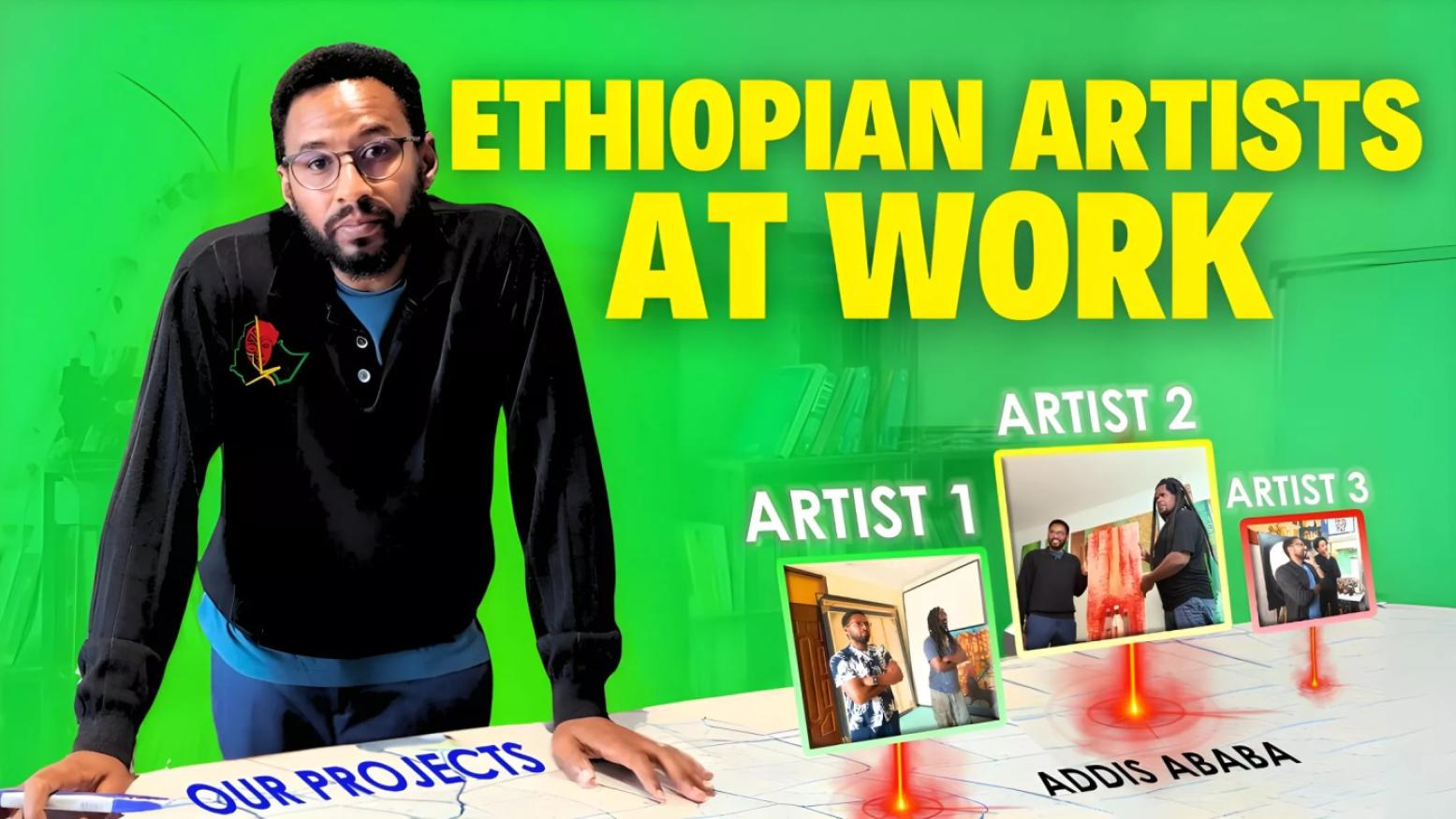
Let me tell you how this started.
Florence, and a family from Dallas
In high school, a family in Dallas took me in. They gave me a home. And because I was part of the family, they took me to Italy.
Think about that for a second. An Ethiopian kid, adopted by a doctor, ends up in Dallas for high school with a whole different family and then lands in Florence. It's a long story. I'll tell the rest another time.
I already knew about the Medici before that trip. Bankers who ran Florence. Fathers of the Renaissance. I knew the name the way you know a name from a book.
Then I stood in Florence.
And I understood, for the first time, what art actually does. Not decoration. Not a nice thing on a wall. I was standing in a whole city that existed because people decided beauty was worth paying for and then kept paying for it, for four hundred years.
Here's the part that never left me.
The Medici didn't paint anything. Not one brushstroke. They were bankers. What they did was find the artists, back them, and make sure the work got made and got seen.
Botticelli. Michelangelo. Donatello. Leonardo.
Not one of those names reaches us without the people who made room for them.
A seed was planted. I walked out of Florence wanting to be that. Not the painter. The one who opens the door.
Could I play that role for my country?
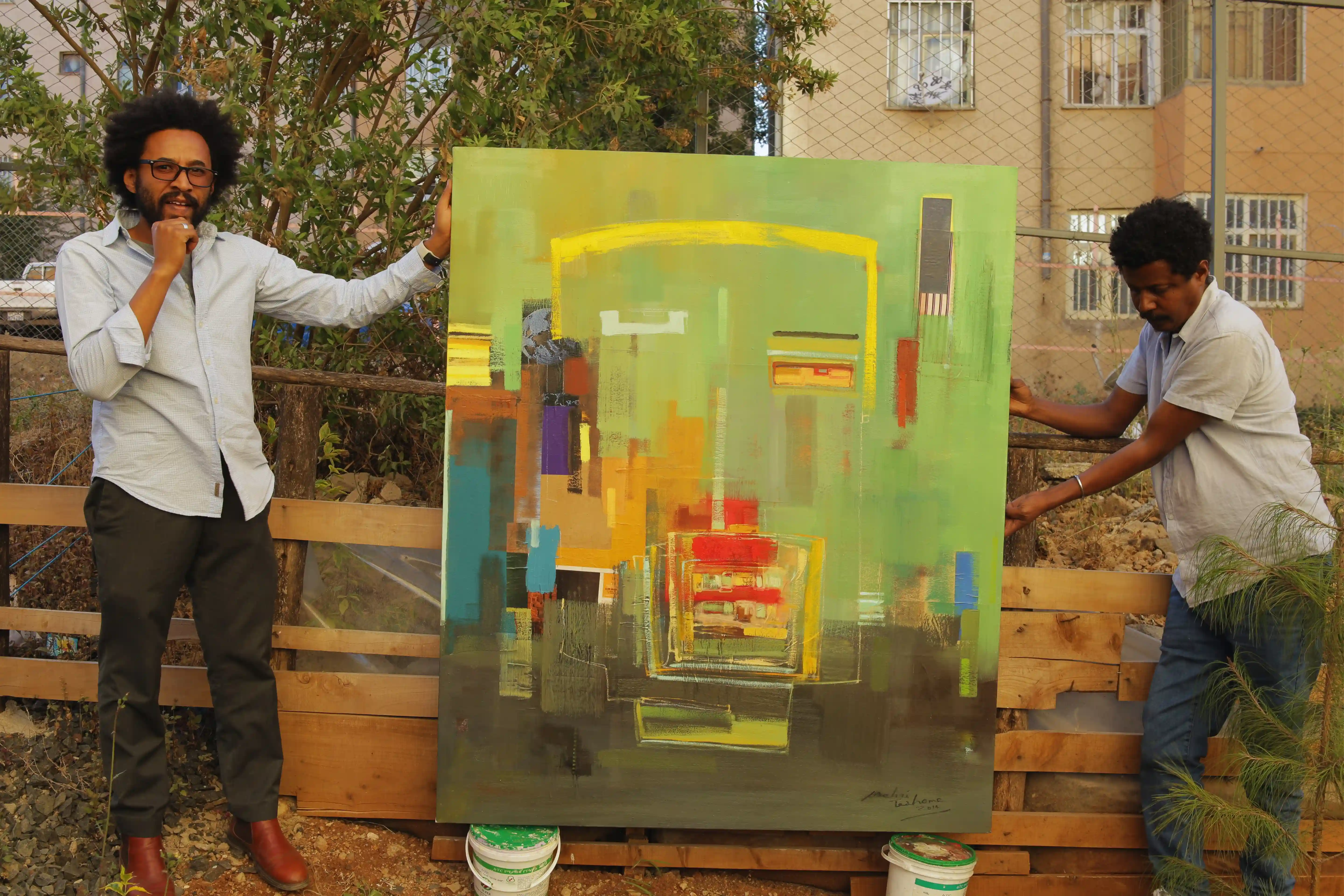
This is round two
I should tell you something before you go further.
This isn't my first attempt.
Years ago, my brother and I started an art company. We called it Ethio-Art Collection. We sold a good amount of work. We were proud of it. And then it ended.
I didn't try again for a long time.
Not because I was busy. Because I was scared.
When something you love doesn't work the first time, the easy thing is to decide it was just a phase. I told myself that for years. I had the idea. I had the artists' numbers sitting in my phone. And I did nothing because starting again meant it could fail again, and this time there'd be nothing to blame but me.
So round two took a very long time to arrive.
But it arrived. And the idea never once left me alone in all those years.
Here is what kept it alive. Ethiopia has three thousand years of image-making illuminated manuscripts, rock churches painted floor to ceiling, a visual grammar entirely its own and no Medici. Nobody whose actual job is to find these artists, back them, and put the work in front of the world.
And for most of that history, painting in Ethiopia belonged to the church. Art about ordinary life about you, about me, about a Tuesday in Addis was essentially not allowed to exist.
Can you believe that?
So who is going to show you the art Ethiopia has?
Nobody was going to.
So I am.
Why "Adulis"
Adulis was the Red Sea port of the Aksumite empire the door Ethiopia used to reach Rome, Egypt, Arabia, India. Gold and ivory went out through it. The world came in through it.
Art is a port too. It is how you get into the soul of a people their light, their memory, what they decided was worth keeping.
So we took the name.
The first show
Every month, ten new works. Not a warehouse. Ten.
The first month came from three artists, and I want you to meet them properly.
Wendwesen Kebede Abera
b. 1983, Dukem
Contemporary abstraction carrying historical narrative. Five of the first ten were his. He says it better than I can:
Abstraction is the physical language of the unseen spirit.
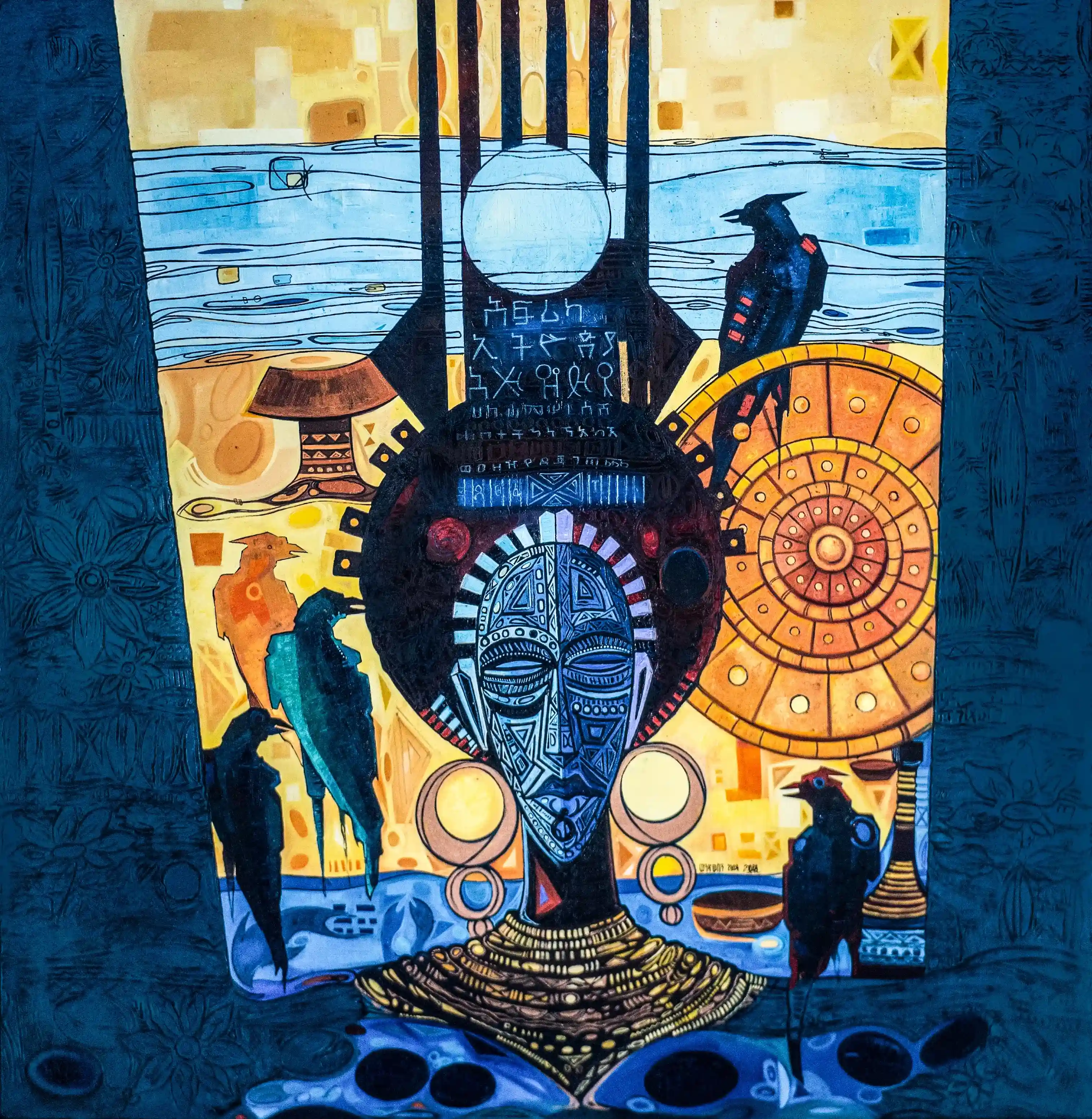
His piece The Unseen Crown is where I'd send someone meeting his work for the first time. Stand in front of it and you understand what he means by "the unseen."
Asnake Melesse
b. 1978, Addis Ababa
Painter and sculptor, moving between abstraction and realism. This is the work that goes straight at Ethiopian faith the priests, the saints, the symbols the church carried for fifteen hundred years.
Ancient symbols are living vessels waiting to be re-awakened.
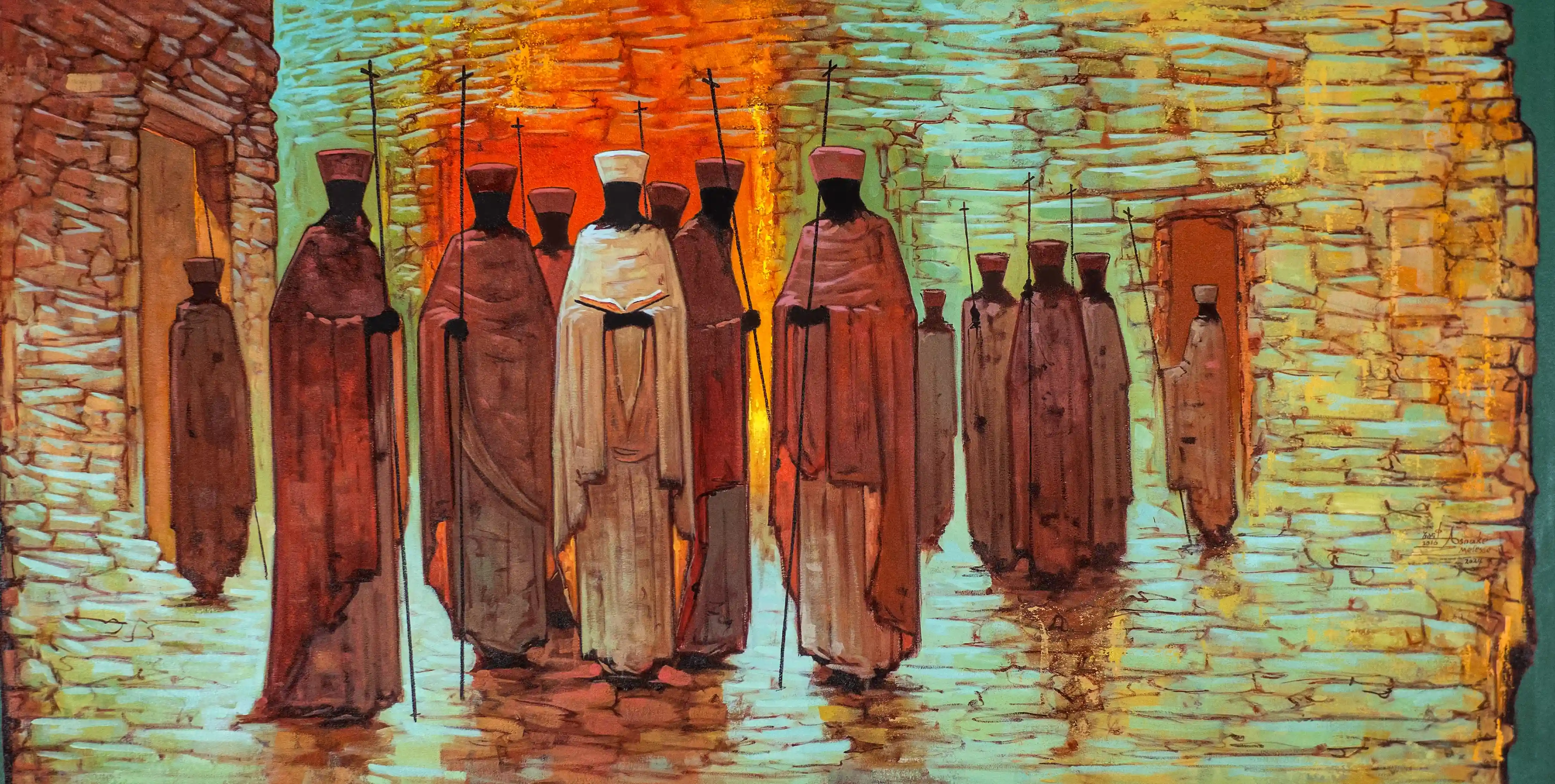
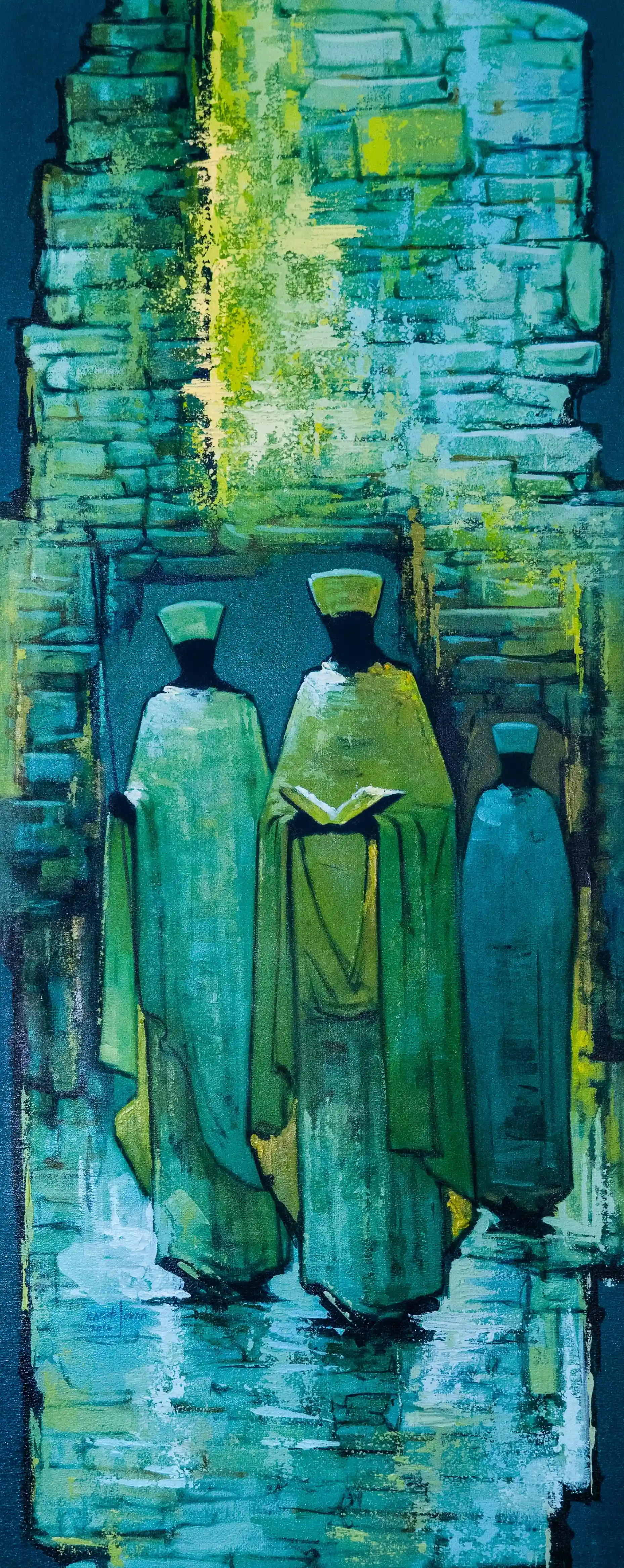
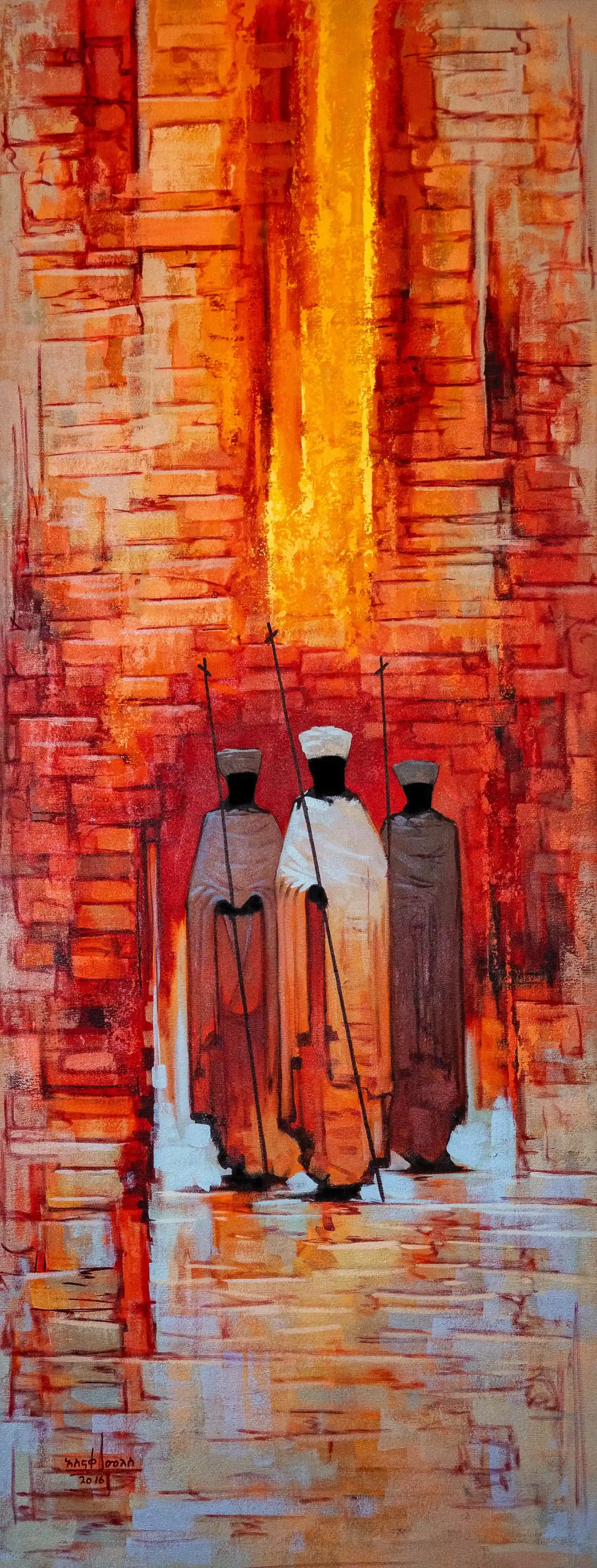
Three of his pieces anchored the opening. The Saints the faces Ethiopia has been painting on church walls since before most of Europe had cathedrals. And the paired works 3 Priest Red and 3 Priest Blue, meant to hang together. Same three men, different key. Splitting them would be like reading half a poem.
Robel Wolde
b. 1993, Addis Ababa
Mixed media realism. The youngest of the three and, I'd argue, the most quietly devastating.
Time leaves a canvas on our walls; my job is simply to reveal it.
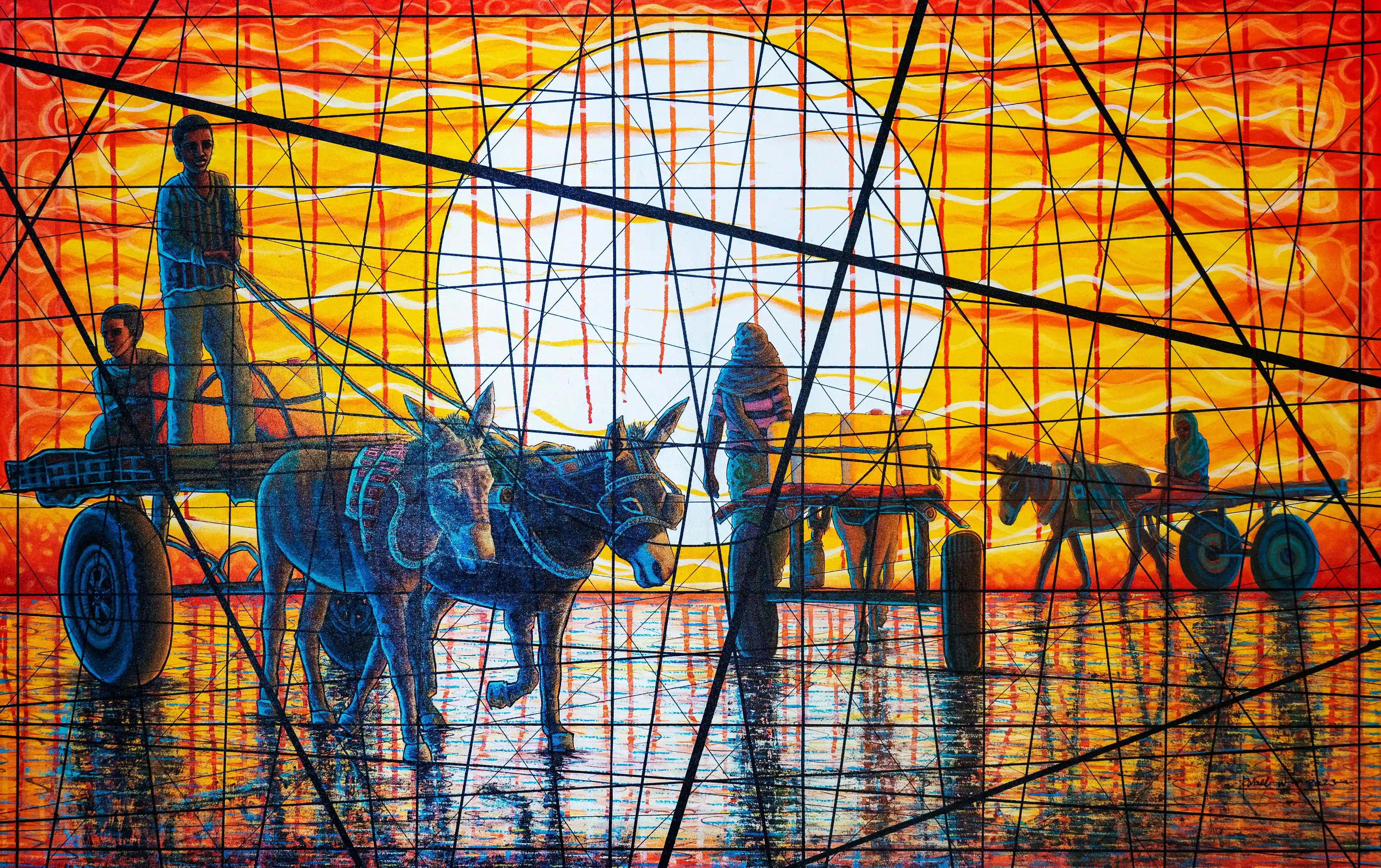
His Sun Chariot is the piece I keep coming back to. Something is arriving and something is leaving, and Robel won't tell you which is which.
Come with us
Now here's the part I'm actually most excited about, and it isn't the selling.
I want you to come discover these artists with us.
Every month we go into the studios. We film it. We sit with the artist while a painting is still half-finished and ask what they're thinking, what the symbols mean, why this colour and not that one. Where they grew up. What they're afraid of. All of it goes onto our channel, Gift of Ethiopia the work, the people, the process, the country it all comes from.
Then we take the artists further. Galleries. Shows. Festivals. City by city, room by room and we document that too, so you're not just watching a painting, you're watching a career happen.
Right now this work reaches you through a screen. I want it reaching you through a room.
One last thing
If you know someone who collects or someone who's had the same empty wall for three years send them here.
The Medici had a network. This is ours, and right now it's you.
Warmly,
Dejene Hodes
Founder, Adulis Ethiopian Art
P.S. I still plan to go back to Florence for a month or two, whenever I can. But I'd rather spend the next stretch of my life making sure that somewhere, someone walks into a room full of Ethiopian work and feels exactly what I felt standing in that city for the first time. That's what this is.