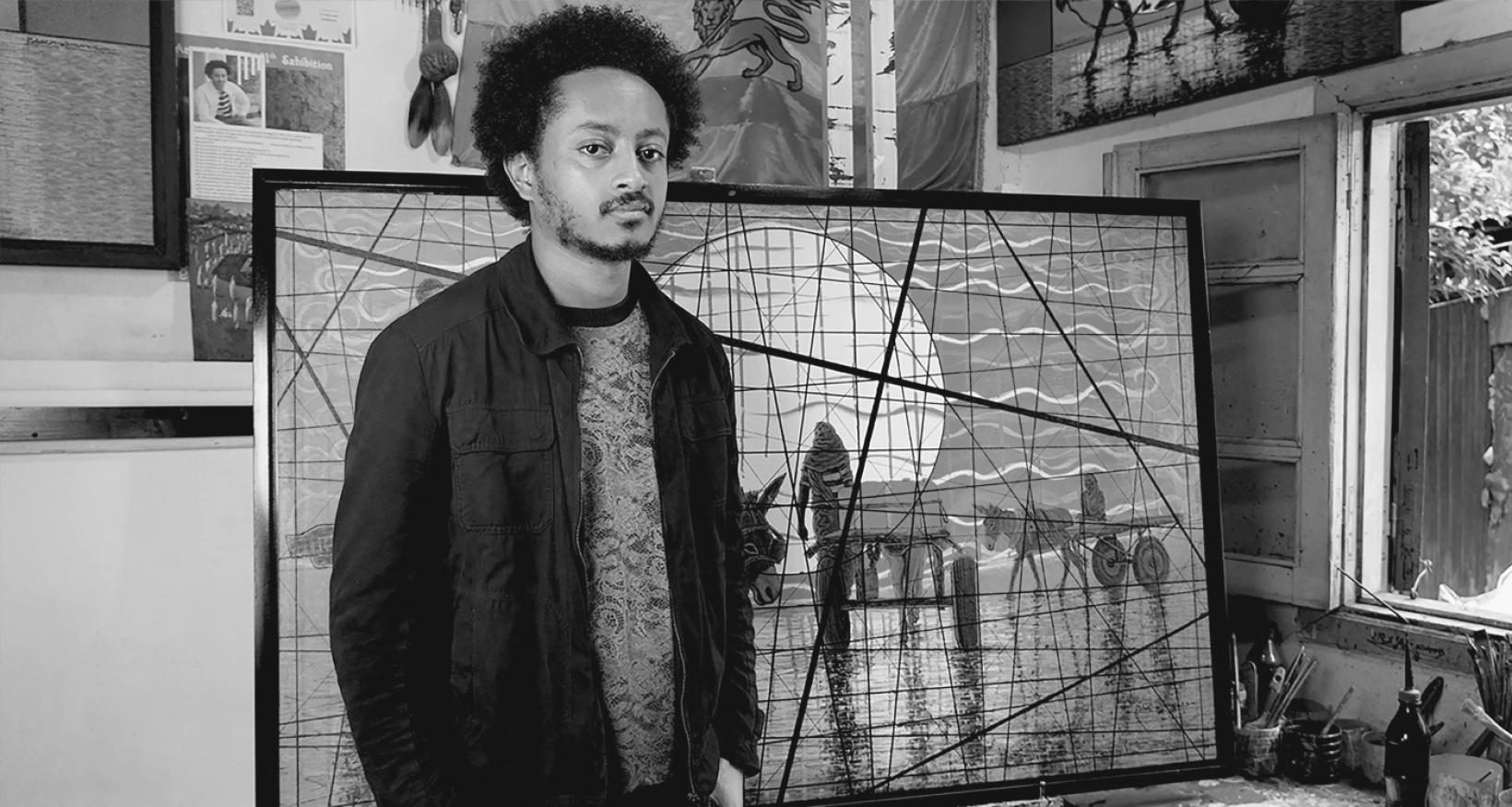
Robel Wolde’s The Journey for Water captures rural Ethiopia’s daily quest with poetic grace. Donkey-pulled carts traverse a reflective wet ground under a golden sun. The figures — unburdened by struggle — embody harmony.
Reading the Painting
Intersecting black lines frame the scene, symbolizing both barriers and connections. Reflections beneath the carts hint at generational endurance — the same walk, made by the same people, across time.
The palette is unusual for a subject often painted in weariness. Robel chooses vibrant oranges and yellows, contrasted by the donkeys’ blue tones. He does not paint the journey as burden. He paints it as rhythm.
The work transforms labour into a celebration of life — not by softening what the labour costs, but by insisting on the dignity of those who bear it.
The Artist
Born in Addis Ababa in 1993, Robel Wolde brings twelve years of studio practice to a distinctly modern lens. Where older generations of Ethiopian painters looked to the sacred, Robel looks to the everyday — the road, the market, the moment before sunrise when the day’s work has not yet begun.
His narratives honour ordinary moments with bold colour and confident composition. The result is work that feels immediate and permanent at once.
Part of a Larger Conversation
Alongside Wendwesen Kebede Abera’s Sun Above the Ancestors and Council of the Eternal Guardians, Robel’s Journey for Water forms part of Adulis’s current season — a triptych of masterworks that read Ethiopia through three different registers: the ancestral, the guardian, and the everyday.
Each is being released as a limited edition of one hundred hand-signed prints. Each is a portal to a chapter of Ethiopia that has been present all along, waiting for the world to slow down enough to see it.