She rises from the canvas with a gaze like prophecy. Her crown is forged from the Afro comb of ancestry. Her voice is written in ancient Ge’ez. She is not myth — she is Ethiopia, uncolonized and unbroken.
For the first time, she is leaving the studio.
Mother of Africa, the newest work by Wendwesen Kebede Abera, has been released in one hundred limited edition prints through Adulis Ethiopian Art. Each print is hand-signed and numbered. Each is bound for collectors who want more than art — who want origin stories in oil.
The Artist
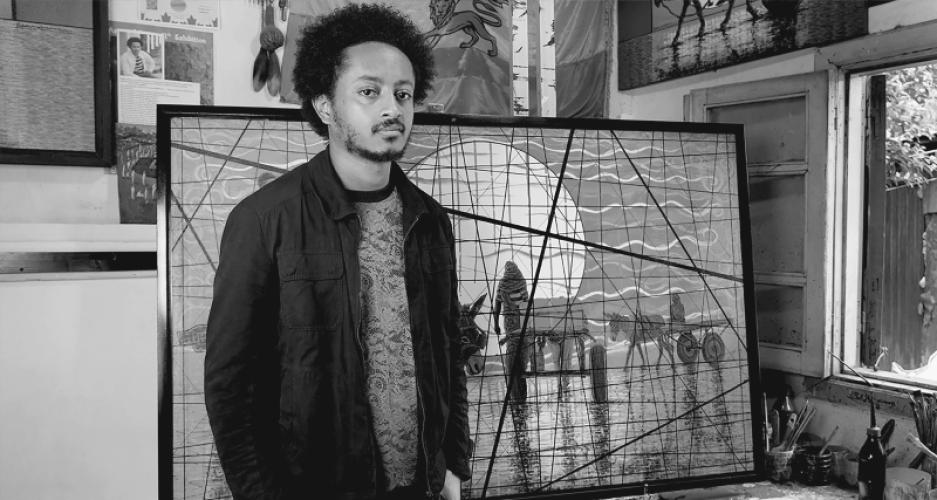
Born in Dukem, Ethiopia in 1983, Wendwesen is more than a painter. He is a keeper of memory. With degrees in both Applied History and Fine Arts from Addis Ababa University, he brings a rare dual fluency: the scholar’s reverence and the painter’s intuition.
His exhibitions have travelled from Addis Ababa to Athens, from Seoul to Dubai. In each, Ethiopia appears not through cliché or caricature but through coded colour, symbolic geometry, and ancestral rhythm. He paints as if the past never ended. For Ethiopia, it hasn’t.
The Symbolism
Every element in Mother of Africa carries weight:
The Afro Comb — crowned above the figure like a throne of identity. A visual anthem of heritage.
Ancient Ge’ez Script — marking "Africa" and "Ethiopia" as living language, proof of a civilization older than most museums.
The Shield — a nod to the only African nation never colonized.
The Crows — perched like guardians. Ancestral protection and wisdom, spiritual messengers caught mid-watch.
The Traditional Wooden Set and Pillow — grounding the divine in the domestic. Culture begins at home.
Rendered in glowing golds, abyssal blues, and geometric blackwork, the painting carries Ethiopia’s beauty, its burden, and its brilliance.
One Hundred, and Only One Hundred
Adulis has made a deliberate decision: this piece will never be mass-produced. Only one hundred prints will be released. Each is hand-signed by Wendwesen. Each is accompanied by a certificate of provenance and catalogued in Adulis’s global archive.
The original will remain in Adulis Ethiopian Art’s private collection, reserved for museums and exhibitions as part of the gallery’s worldwide effort to bring Ethiopian art to institutions across the globe.
To own one of these prints is to own a piece of a story that must continue to be told.
Mother of Africa stands in a lineage of culturally defining masterworks. Like Kehinde Wiley’s reinterpretations of power, like Frida Kahlo’s confrontations with cultural lineage, like Basquiat’s coded expressions of Black memory — Wendwesen’s work transcends paint and canvas. It is a political, cultural, and historical act of storytelling.
This is more than a sale. It is an act of preservation.